http://www.facebook.com/pages/Vintuous/152929804815516


Tuesday, 3 July 2012

Thanks to Ali for nominating me for the Versatile Blogger award!  http://alibeecreations.blogspot.com

I have to write (admit) seven random facts about myself. Tricky one...
1)  I am a super-taster.  Despite the fact I thought, when I was a child, that blue cheese smelled like old socks, I now love it! 
2)  I have had a poem and a short story published (on websites...)
3)  I love the poet John Burnside.  I saw him speak at my university and then, many years later, I saw him speak at the Edinburgh Book Festival.  It was like meeting a celebrity.  I got tongue-tied!
4)  I cried when I saw Death of a Salesman.  I was sitting in the front row and may have embarassed the actors...
5)  I can recite To a Mouse and To a Haggis off by heart.  Still working on Tam o'Shanter.
6)  To celebrate Eurovision 1999, myself and a number of pan-European friends, played a drinking game which culminated in us all having to sing a song in our mother tongue.  I sang the Scottish, Caledonia and won the competition, winning a large glass of red wine for my trouble.  We were drunk and misty eyed.  To regain composure, myself, a Finn and an American (yes, not European, but still got to enter the competition because we're all inclusive) went skinny dipping in the Adriatic.  Not too clever when I think back: drunk and swimming in unknown waters.  Even more unnerving was the moment when, as we emerged from the water, slightly less drunk, but pretty naked, we were illuminated by the full-beam headlights of a man who had, presumably been watching us for some time.  He left his vehicle, pursuing us up the beach as we ran, stumbled and tried to put on our soggy clothes with as much decorum as we could muster. 
7) Slept with a sausage.  (Had a house-warming party in Hungary when I shared a flat with the afore-mentioned American girl.  We had a punch bowl... I almost don't have to tell the rest of this tale...  Needless to say, it was messy.  We had to go out, however, as were disturbing out neighbours who were early risers.  We headed out to the pub and the only reason I know what happened, is because I took photographs, which I had developed many weeks later.  It was 1999: digital photography was but a speck of technology on the horizon.  I digress.  We had tequilla, played table-football and then ran home in the snow.  I must have arrived home, needed some food, so took a Hungarian sausage to bed.  I didn't have the energy to eat it, so woke to find it happily uneaten and slightly withered by body-heat in the morning.  My lovely American friend was asleep in a pile of crisps, so she can't assume the position of the innocent.  I blame the fact that there was not such a thing as a take-away kebab shop in Southern Hungary in the late nineties.)

I really do have to stop there, or my explanations will get longer and longer! 

So, now I have to nominate fifteen other bloggers for this award.  I will go in search and will return to this post at a later date!

Tuesday, 29 May 2012

Mon panache.

I haven't posted in ages. Suffice to say that it has been a busy, strange time.

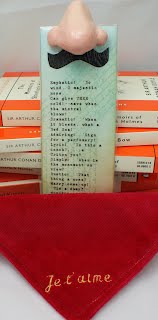
Over the last few weeks, I have come up with a couple of new designs for my "Nose Stuck in a Book" range of bookmarks. As the most prominent thing about them is the large nose applied to the top of them, it didn't take me long to return again and again to the image of Hercule Savinien Cyrano de Bergerac, from Edmond Rostand's play, or the French film I remember watching as a sixteen year old girl, alone and in the dark.

The image of the wonderful GĂ©rard Depardieu as he stood under Roxanne’s balcony is an enduring one for me. Even if now I am more wizened, slightly more cynical and a tad less whimsical, I can still recall how I loved the moment when Cyrano finds he can speak to Roxanne from the heart and she, thinking he is the dashing Christian, falls completely in love. Cyrano speaks on Christian’s behalf, who, although beautiful does not have a poet’s soul. Cyrano, has a large nose, a metaphor for his cripplingly low self-esteem in matters of the heart and society’s focus on outer beauty.

Cyrano’s character is clever, witty, bombastic to the point of verbosity, which, ironically is an outer show of his wit and intellect. It is his emotions that are hidden, except as he stands in the dark, able to enjoy a moment of truth with the woman he loves: “Yes, the feeling which fills me is true love! Fierce and jealous and sad, yet never selfish. I would gladly lay down my own happiness for yours, even if you were never to know it. And even if I end up far away from you and lonely, I will be content just to hear a happy echo of the joy I once brought you! Each glance from you makes me virtuous and brave in new and unknown ways. Do you begin to understand me? Now, after all this time, have you begun to understand? Do you feel my soul climbing up to you through the darkness of this night? Oh, it is too sweet, too incredible, that I should speak this way and that you should listen! Even in moments when my hopes rose so high, I never could have hoped for this much! I could die peacefully right now. My words have had the power to make you tremble! You are trembling, I can feel it! I can feel the quivering of your hand echoing down through the jasmine branches!”

 It is his words she falls for, but Christian’s beauty. They marry in secret before both Cyrano and Christian go to war. Of course, Christian dies and Roxanne mourns him. Due to Cyrano’s initial deception, he cannot then sully Christian’s memory with the truth. Christian dies the romantic hero. It is only later, as Cyrano is dying in Roxanne’s arms, Roxanne having lived in a convent for ten years, she realises that it was Cyrano, the great poet, whom she loved all those years earlier. Ever unpopular , some lackeys dropped a piece of wood in his head, smashing his skull.

 He asks her about the last letter Christian sent to her before he died and she tells him that she keeps it with her always, that it is stained with Christian’s blood and tears. Cyrano, in the dusky light says that he would like to read it; he reads it aloud, even as it grows too dark to see. Roxanne realises that the voice she is hearing is the voice she heard under the balcony all those years before. Cyrano denies it because the blood on the letter is Christian’s. When Cyrano dies, Roxanne loses the man she loves for a second time. Despite being a decorated war hero he dies unfulfilled because he could not emerge from out of the darkness under the balcony.

 I read it in English. I read it in French. I watched the film again and again. Two years ago, I went to Bergerac in France to visit the statue of Cyrano, despite the fact the actual Cyrano never lived there. The statue is pretty, and as it was our wooden anniversary, my husband acquired a wooden Cyrano head with the pervasive “prize turnip” protruding from the centre of his carved face. It was rather lovely to return to those adolescent feelings of romance: to the tragedy of unrequited love. I don’t think I’ve seen the film or read the play in ten years, but sometimes I fear returning to something so of its time in case it becomes tarnished by a new perspective.
These memories returned to me as I crafted Cyrano’s nose and made him a red handkerchief to wear over it, just as he wore under Roxanne’s balcony. Even if no one ever wants to own one for themselves, I enjoyed the nostalgic journey.

Monday, 16 April 2012

Life, death, the universe...


Tracy K. Smith just won the Pulitzer Prize for poetry.  She handles such weighty topics as life, death, the universe.  I haven’t read her book, although I will.  I read a review in the New Yorker and came across this:
We are here for what amounts to a few hours,
                                               a day at most.
We feel around making sense of the terrain,
                                               our own new limbs,
Bumping up against a herd of bodies
                                               until one becomes home.
Moments sweep past. The grass bends
                                               then learns again to stand.

It seems so strange to have come across this writer today and this quotation which eloquently describes the fleeting nature of life.  My second cousin died today.  He was 36.  It was an accident: he fell backwards down some stairs.  His wife had to give consent to switch off his life support machine. They had been married just over a year. He’d been on a stag weekend and now he is dead.  The facts are stark laid out in black and white and I write them with a certainty I don’t feel.  How do we make sense of tragedy?  How can I write about it without hyperbole and meaningless emotive language, dragged out from my vocabulary as acceptable words for grief?  

As my mum told me what had happened, my mind took me to a very sharp memory, a mind-picture with an incredible sensory texture: my sister must have been three or four and our cousin must have been no more than ten.  She is on his knee and her blonde hair is plaited tightly in French pleats; she’s wearing a black and white summer dress.  Her arms are thrown around him and she’s aiming for a kiss.  She is smiling a wicked smile, eyes closed and his smile is spontaneous as he clutches her, eyes closed.  They’re sitting on an old reclining garden chair, which is covered in a big, yellow, floral fabric.  I remember how it smelled: like sunshine and musty patience.  It lived in the shed and didn’t get out much in Scotland, but if it did, we’d all fight over it; it was so comfortable.  He’s wearing a V-neck blue jumper and jeans, and he is so, so young, unburdened, happy in the moment.

Their family was so much a part of ours as we grew up, despite our differences in age.  His mum was my mum’s best friend.  She passed away last Summer after having developed cancer of the brain.  It was quick, but so very painful.  She was of ages with my mum and her daughter had a daughter about the time I had my first son.  My second son is asleep tonight wrapped in a blanket she gave us when our first son was born.  I think of her often.  She would come to my parents’ house with her husband (who is such a generous man) every New Year and would sing, “She Moves Through the Fair” with her faint Irish brogue touching each familiar syllable. When she died, I wrote a poem for her because I wanted to capture what I remembered before it was too far away, and also, I wanted to, somehow, give a shape to my grief, if that’s even possible.  I took words and images from, “She Moves Through the Fair” and saw the fair as a metaphor for life, which we visit, as Tracy K Smith so eloquently says, “for what amounts to a few hours.”
“…a joy forever…”

Obsidian eyes, hair pitch, with the sureness of calligraphy ink,
She goes to the fair, feet embraced by the bite of spring dew.
Merchants with myriad wares, watch as she lingers
By a mandolin player picking notes of the folk song;
Her voice, mellifluous, she sings the tune, habitually,
as sure as one year leads in to another.

She moves through the fair enveloped in melody,
Eyes sharp, assured with flaming zeal,
And unravels a hand, as if that hand,
Were proffered with earnestness as vast as the Irish Sea;
This great man makes a star a constellation:
Discord, harmony; spring, summer. 

Close your eyes, you’ll hear that voice again,
Ageless as light.  Her feet make no din as the swan migrates,
Volant in to the wintry mists,
Her footsteps an enduring memory to generations,
A thing of beauty, a joy forever,
That does not pass into nothingness.

I sent this poem to her husband in a card because I couldn’t bring myself to write empty condolences.  Metaphor is the only way to get close to the abstract and to emotion and feeling that defy concrete terms. 

Her husband, who is lost without her, was on that stag do, too.  He was there when my cousin died and I just don’t know how a broken soul can withstand losing two people so suddenly and within a year of each other.  Can the grass really bend and then ”[learn] again to stand”?


Wednesday, 4 April 2012

New bookmarks all ready to customise!


Well, today was a busy day.  I managed to complete some of my bookmarks.  I've been playing around with the idea for ages, but made the noses from air-drying clay to start with, which was hopeless!  Too heavy.  The ones in the picture are made from super-light clay, which is unbreakable... useful for 'extreme-readers'! 

(They're for sale on Etsy.com.)

Tuesday, 13 March 2012

"A Visit from the Goon Squad."


When I teach kids how to write a good personal, reflective essay I tell them that they have to understand the experience they are writing about in context, so that they know how to balance the retelling of it.  I mean that in order to create pace, to engage their reader, they can’t spend five hundred words describing the car journey to the airport and then the last four hundred words describing the rest of their holiday.  Actually, writing about holidays is banned in my classroom, unless a young person has something reflective to say about their fortnight in Lanzarote.  Some do, don’t get me wrong: I read a wonderful essay written by a sixteen year old girl about her memory of going to Venice with her family. It was the last holiday they had before her parents split up.  She balanced her descriptions beautifully.  The pathos was in her memory of the beauty of Venice set against how unhappy she felt that this was the last time her family were happy.  

If only we could see all experiences with the benefit of a holistic understanding, with the benefit of a universal perspective. 

I’ve just read Jennifer Egan’s, “A Visit From the Goon Squad” and have loved it.  It made me cry in unexpected places, for unexpected reasons.  One of the characters explains that Time is a “goon;” this “goon” can be avoided by no one.  It is something we take for granted until we're running out of it, or until we realise that we didn't notice so much of it pass.   It’s a strange book because it doesn’t have a single narrative thread, although each chapter is connected to the next by a single, sometimes marginal, character.  For example, one chapter is about Sasha, a kleptomaniac who is seeking help for her condition, and the following chapter is about Bennie, a music producer whose assistant is Sasha.   Later, Sasha’s daughter narrates a chapter, about her autistic brother, through the medium of a Power Point presentation. He is obsessed by the pauses in rock songs, which seems to be a metaphor for the way he and his father cannot understand each other; they cannot communicate.  Although they are connected, they are disconnected.  No amount of technology can change it.  Only they can come together to find a way to understand each other.

Beyond family, each, sometimes very disparate, life impacts upon another: each person memorable and important in their own right.  Every character leaves a kind of residue wherever they go, on whomever they meet and this somehow changes them, negatively in some cases, positively in others.  Without us knowing it, we are part of other people's stories, other people's narratives and that role can be minor, or can be starring. We don't always have the ability to perceive it. 

What Egan has her narrators do is see their lives with the benefit of perspective.  Even moments of happiness and freedom can be imbued with a sense of loss.  Lou’s daughter remembers being in Africa with her father, her brother and her father’s girlfriend.  She remembers watching her brother dance without self-consciousness; she remembers how happy he was at that moment, but in the context of his life and her life, it’s a moment infused with pain and dreadful loss.  Her brother killed himself years later, leaving a tear in their fabric.

This is what I take from this novel because it's what impacted upon me, but someone else would highlight other aspects for reflection.  Their retelling of the same story would be different, just as each perception of every moment is different.

It made me think about how we can try to take a broader perspective.  When something awful happens in my life, I can be burdened dreadfully by it.  Like many, I can feel that I cannot unload the misery because I can’t imagine that it will have an end.  Perhaps, what I should do instead, is try to be reflective: imagine this pain in the broader context of life.   Will this horrible experience be the catalyst for change?  Will it spur me in a direction I could not have taken otherwise?  Can I muster optimism merely from imagining that each dark moment will have its antithesis?  Can I remove 'myself' from my own narrative and see it more objectively?

Last week, a close friend of mine was sitting in her living-room, having just changed her two-and-a-half year old daughter into her pyjamas.  The doorbell rang.  It was her neighbour.  She told them that she had discovered that their other neighbour’s house was on fire.  She, her husband, her daughter left their home, thinking that they’d be back inside within minutes, but soon, they realised that the fire had spread across their roof and was engulfing their home and everything they owned.  She, heavily pregnant, I may add, watched as, very quickly, their home turned to nothing.  Next to nothing was salvageable.  They had the clothes they stood up in and, luckily, she had her handbag and car keys. 

I saw her yesterday, and although still in shock and tearful, she remained incredibly pragmatic.  What else could she be?  No amount of anger could undo what had happened.  (It was arson-they suspect the neighbour torched his house because it was due to be repossessed)  But, she laughed, saying that it was a good opportunity for a new start, closer to her parents' home and, as they’re expecting baby number two, that was a positive outcome. Wow.  Even in her darkest moment, she has found a way to find perspective.  Her husband may have lost his thousand- strong CD collection, amassed over a lifetime, but they are only things and can be replaced.  

I gave her “Goon Squad” as the first book to put on her new shelf in her new home, but I have a feeling that she is the type of person who has already learned its lesson. 

Thursday, 8 March 2012

Mother's Day is coming. Thoughts on motherhood.


If asked what it means to me to be a mum, I would reply that it is a difficult question to really answer.  If I were asked in passing by a stranger I would probably, skip the complexities and just say, “Amazing,” because the nitty gritty is just too…gritty.  That’s not to say that being a mum is not “Amazing”.  Sometimes I look at my two young boys and almost bubble over with ebullience.  I could have tried in vain to get my toddler to go back to sleep between the hours of three and five in the morning, but upon hearing the gurgling and giggling of my five month old in his cot at six o’clock, my tiredness and grumpiness quite literally (well, metaphorically) melts.  

In a nutshell, being a mum is hard work, but there’s always a pay-off.  

Having children with the love of my life was a goal, no, an expectation when I married eight years ago, but when it proved hard to conceive, I felt my already imagined future slip away.  Month after month would pass and we did not see the faint pink line appear on a test.  More and more of my friends were announcing pregnancy with blushing cheeks and glowing happiness and it was hard not to feel the bitter disappointment of my own failure to bloom.  

Like many before us, we went to the doctor to get advice and we began on the treadmill of fertility tests, culminating in my husband facing clinical, embarrassing assessments at the hospital one day while I was at work.  It was an experience he wasn’t so eager to share with me, but he went through with it because he, as I did, wanted to fix what was not right. 

We eagerly, but with trepidation, awaited the results.   We waited.  Waited.  The waiting made me feel nauseous, made me feel sore, bloated… When we saw the Dr initially, she told us to go out and buy a Two-seater Sports car.  With a vehicle too tiny to take someone too tiny, surely fate would lend us a hand.  The fertility tests proved to be our Sports car.  We were pregnant and we were so excited, happy, scared, so grateful for the opportunity to start a family together.  I do not forget how it felt to imagine that I would not have a child of my own, the utter frustration of it, but juxtaposed in my memory, the delight was all-encompassing. 

Despite twelve weeks of vomiting, I still faced the porcelain bowl with a sense of accomplishment.  If I felt so bad, surely this was good.  I really did blossom and by five months, I was proud of my round tummy and never tired of the kicks which grew in power and agility.  I remember the first time we saw him on a scan, when we first heard his heartbeat, when shamefully, after X-Factor in October 2009, my waters ruptured one week after my due date and we rushed into the hospital.  Rory was born the following morning, the birth being a blur in my memory because the “pay-off” was so profoundly life-changing. 

 Like so many new parents, we felt like such novices: conspicuous in our ineptitude.  We had to ask a nurse how to take his clothes off to change a nappy.  He just seemed so tiny, so terrifyingly dependent.  Six weeks of sleeplessness ensued, followed by the pay-off: he learned to smile.  He engaged with us, recognised us, began to play, to roll over, to eat solid food, to sit up, to stand, to walk, to talk, to literally monologue every thought and emotion from the moment he got up in the morning to the moment he went to sleep at night.  

He learned to assert himself, to demand things his way, to scream in public, to show incredible affection, to surprise us every day with his growing vocabulary and ability to piece together jigsaws for five year olds.  (He’s only now two and a half) On the one hand, he is a handful, but on the other hand, he is “Amazing.”  He can say, “Please,” “Thankyou” and “I love you so much, Mummy.”  The pay-off for the hard work.  

How do I feel about being a mum?  Well, we were lucky enough to be blessed with another little boy just after Rory’s second birthday and we’re enjoying watching him go through the same incredibly fast journey through baby-hood.  Parenthood is hard, tiring, it takes every last scrap of your energy, but it’s also addictive.  Perhaps, in the not-too-distant-future, I’ll be writing about baby number three.